Thursday, May 26, 2011

The first Two Stroke Saab. The Ursaab/Saab 92

From the Saab Museum in Trollhatten, Sweden. Amazingly this prototype is still in working order today

Aircraft Company, Saab, realised as World War II came to a close, the market for Military
Aircraft which had been their bread and butter for so long, was also ending.
They had been manufacturing Aircraft since 1937, when the company was set up for
specifically that purpose by the Goverment.
Their first Planes were copies of German models that they built under license.
Shortly after this, they began to make their own aircraft and quickly obtained a
reputation for making high quality, fast planes.

They knew that in order to survive financially, they had to diversify into other things.
They considered many things including, Fitted Kitchens, Motorcycles, Cars, Vans and
Trucks.
Most of these fields already had established manufacturers in Sweden already, lIke
Scania for Trucks and Volvo for Cars.
Saab realised though that Volvo cars were quite pricey and what Sweden needed was a
small, affordable and reliable car for families and people of average means.
So, Saab sought to develop such a car and fill a niche in the marketplace.

This project was given the name 'Project 92' and twenty people were recruited to develop it.
Out of these twenty, about fifteen were Aircraft Engineers.
Stylist Sixten Sason  was responsible for designing the body of the car, and
Engineer Gunnar Ljungström was the brain behind the technical aspects.

All two stroke Saabs had a freewheel fitted and all were water-cooled.

The Ursaab

A 1:10 scale model Ursaab was tested in a wind tunnel  and gave a drag coefficient of 0.32,
an impressive figure even by today's standards.
Ursaab is Swedish for 'original Saab'.
The body drawings were completed by January 1946 and a full sized model was ready by
April of the same year, reputedly coated in black boot polish!
(whether there's any truth to this, I don't know.)
Although nowadays, the beautiful styling of this car is apparent to all lovers of classic
cars, at the time there was a mixed reaction to the styling and it came in for quite a bit
of criticism and trepidation on the part of Saab's own management team.
Engineer Ljungstrom said "...if it can save 100 litres of fuel a year, it doesn't matter if it looks
 like a frog."
This first prototype was given the number 92/001 and was made using a steel body,
an 18hp DKW two stroke engine, an Auto-Union fuel tank and many other parts were
sourced from scrap yards.
The car was front wheel drive, with a  monocoque body, which was very unusual and
advanced for it's time in the 1940's. The styling and sleek aerodynamic lines show it's
Aviation inspired pedigree.
Saab have always been considered to have been a little bit different and unconventional
from the norm of Car makers( at least until they were taken over in modern times by Gm).
The prototype was ready by the end of the Summer, 1946 and was immediately tested
night and day under the most rigorous conditons.

The testing showed ways in which the car needed to be improved.
One of the problems encountered was that the car's wheels were too close
to the bodywork and would get easily clogged up with snow in Winter.
It was decided also that the doors were too thick, heavy and impractical.
Otherwise the car stood up remarkably well to the rigours of it's testing.
One Swedish newspaper of the time, reported that Ursaab had "...defied all efforts
 of its driver to destroy it." (Over 50 years later, this Car can still be seen in the
Saab Museum in Trollhatten, Sweden and is still in full working order.)

There were three of these identical prototypes used for testing and between
them clocked up over 530,000 km- equivalent to thirteen journeys around the
world to ensure thorough testing under every known driving condition.

Any colour as long as it's green, baby!. Rear shot of 1951 car.


In 1947, their factory in Trollhatten was adapted for mass production to
build this car. They had to bust a hole in the roof to install a tall body
stamping press.

Further pre-production prototypes were tested and it wasn't until June, 1949 that
the Saab 92 was launched to the Public and Press.
Full scale production started in December of that year and  1246 cars were
made by the end of 1950.
All of these 1950 cars were painted in Green, similar to Henry Ford's mantra of
any colour as long as it's black,albeit green in this case.
An unsubstantiated rumour is that the Saab had vast stocks of this paint left
over from their manufacture of military planes and used it as a cost cutting measure,
which I believe is highly probable.
Only 17% of the Saab 92 was made from imported materials.


1947 Saab 92


Saab 92  1950-52

They managed to produce around 9000 cars in the first four years of production, yet
waiting lists were large, such was the demand for the car.
The Saab 92's engine was similar to the Ursaab prototype, of DKw origin but with a
higher power output of 25hp and a displacement of 764cc, with water-cooling.
This was a two cylinder engine, very similar to the one that would later power the forerunner
to the Trabant, the Zwickau P70 and was also transversely mounted.
So typical of Dkw engines, the radiator sat behind the engine, close to the bulkhead.
It had a three speed gearbox with a column change.
It's maximum speed was 105 kmph(62.5 mph), which was excellent performance for these
times from such a small engine.
The suspension was extremely clever and I think, anyway, heavily influenced by Dkw, and
utilised torsion bars.
The boot could only be opened from inside the car, making it not very practical.
The car had a 6 volt electrical system.
It's fuel-mixing ratio, petrol to two stroke oil was 25:1.

Saab 92 De-luxe, 1951.


The only change Saab made to the 92 in 1951, was the dashboard instruments were
changed from the American 'Stewart-Warner' type to the German Vdo brand.
It's not clear why this was change was implemented. I suspect the VDO were easier
obtained and probably more cost effective.


Saab continued to update this car and make many improvements with subsequent models, 93,95, and the Saab 96 for a time, was the last one to use Dkw two stroke power until 1967 when a v4 Ford engine was implemented and two stroke Saab production ended.
The Two stroke Saab's had remarkable success on the World Rally circuit with many, many victories and successes.
Famous Rally driver Erik Carlsson in particular had many big wins to his credit.


1951 Saab 92 Interior.


The 1st People's Car from Japan. Two stroke Subaru 360:

Subaru 360:  1958- 1971

1958 Subaru 360


With it's engine of just 360cc, you might consider this to be in the microcar class, but
this car did provide room for 4 passengers, albeit small ones and also produced
commercial versions, a flat bed truck and panel van.
Furthermore, the Subaru was an excellently engineered car.
 It was the first car mass produced car to be made by the company.
It's cute styling and shape earned it the nickname 'ladybird'.
It looks a little like the Beetle and also the Fiat 500 of the time.

360 engine


Whilst Dkw, the Pioneers of Two stroke technology, also made their cars front wheel drive,
Subaru followed the VW Beetle with a rear wheel drive, rear engined layout that was also
mounted transversely. Like the Beetle it was also air cooled.
The car taxation policy in Japan at the time ruled that cars with engines of less than
360cc displacement qualified for the lowest taxation bracket, called the Kei class.
The reason this low tax incentive existed was to ease the congestion in Japan's cities
that was growing at an alarming rate. The Kei class was implemented in 1955.
In addition to the engine restriction, to qualify, there were also dimension restraints to
comply with.
Cars had to be no longer than 9 feet, 10 inches.
Owers of K class vehicles were also permitted to park their cars overnight in city
streets, which was forbidden at the time to all other vehicles.

Subaru Sambar Flat bed truck


The Subaru 360 came in at just under 9 feet, 6 inches ( 2990mm) and 356cc, so
it was clearly designed to fit into this class.
It's tiny engine was pretty powerful for these times and the 2 stroke unit developed
16 Hp in its initial format. This added to a low body weight of around 1000 lbs made
the car perform remarkably well given its small engine.

Top speed was 60 mph and it was claimed by Subaru that the car was capable
of returning up to 65 mpg. ( my own feeling here is that the car was undoubtedly
economical, but not to the tune of Subaru's claims)
The decision to use a 2 stroke engine must have been an easy one, given that
two strokes pack twice as much power into the same space as four strokes, and
are also lighter, simpler and cheaper to make.
A four stroke engine of just 360cc would've been a lot slower.

The Subaru was a one piece, monocoque construction which was still unusual and
pretty forward thinking in 1958.
Early models needed their 2 stroke oil premixed with the fuel, of which the fuel cap
doubled as an oil measuring cup
Later models had the 'Subarumatic' automatic oil mixing  lubrication system.
This appears to have been more successful and somewhat simpler than the ill-fated
system made by Dkw in 1961.

Subaru Sambar Minibus


The 360 despite the negative press it got in the Usa, was a well engineered and competent
car that enabled the fledgling Subaru company to get a foothold in the world of car manufacturing.
It spawned a Kei class 'War' that saw rival companies such as Honda and Daihatsu build
alternatives that were spawned on the success of the 360.
What set the Subaru apart and makes it so commendable is the fact that the car was designed
exclusively in-house, from its styling to its mechanics. For a manufacturer new to car making,
it was an excellent achievement. Most car makers using two stroke engines at the time were
either getting their engines from Dkw or had copied Dkw's designs.
In the Post-War period that existed in Japan, there was little innovation and much copying.
This was due to both lack of money for development and a lack of technical expertise.
What the Japanese  became famous for was for first copying or adopting technology,
 then improving it over time.

Interior view of the Subaru 360


To put Subaru's accomplishment in making the 360 into perspective, at the time of the
360's inception, Nissan were producing Austin A50's in Japan under license.
Isuzu and Hino were doing the same with the Hillman Minx and Renault 4CV respectively.
All of these companies would eventually thrive with designs of their own, but not until
later and after they had ' cut their teeth' in manufacturing 'old' Western designs.

1950's Japan was desperately rebuilding itself ( like Europe) after WWII.
Most people couldn't afford a new car, only a motorcycle or Scooter.
The 360 bridged that gap and enabled people in the market for a two wheeler, to buy
a proper car for the first time, such was its competitive pricing.
In this sense, the 360 was the first genuine people's car of Japan.

1967 Subaru 360


Friday, May 20, 2011

Great car, the 311

Having had the car out a few times and over 300 km of driving, I can say that the 311 is a super car.
There's not a rattle from anywhere on the car and the handling is brilliant on corners, thanks to the leaf spring suspension, without the body roll that afflicts the Wartburgs 312 and 353.
Wartburg 311's were actually imported into Ireland before the Uk, in the late 1950's or early 60's.
Very little information exists on this and they were only imported into Ireland for a short time and were not big sellers.
I believe that mine is currently the only 311 on the road in Ireland.

Having had 2 x 353's, I can say that the 311 is a far better car with a much better build quality than the 353.
Although they share mechanical similarities under the bonnet, the 311 oozes class and with its sleek body lines and curved panels and glass,  it's no surprise that the same workforce that assembled this car used to make luxury Bmw's in the same Eisenach factory. To compare the fit and finish of the bodywork seams and panels, between the 2 cars is like night and day.

For a car first made in 1955/56 the 311 must have been years ahead of contemporary competition as they drive so well and are not difficult to manoeuvre. Visibility for an old car is also very good.
I doubt anything that Dkw were producing of the same era was as good, which is praise indeed, given that the Wartburg's mechanicals owe so much to the former.

The only downside to the 311 compared to the 353 is that it requires more maintenance, namely the many greasing points that must be regularly addressed. But, that's a small price to pay for such a wonderful classic and all 50's and 60's cars usually have them.
Interestingly some early 311's were fitted with a central lubrication system that the driver activated periodically with his foot to pump grease into the required points. I wonder why they later discontinued this system, whether drivers were neglecting to do it or it became problematic, I don't know.

My car has been retrimmed at some point with white leather seats. Whether they were originally leather or cloth is anyones guess as they came in both. The seats are reminiscent of classic French cars as they're softly sprung and comfortable.
The large steering wheel is a lovely feature,a s is the column gear change whose ratio's operate in nearly the exact opposite to that of the Trabant. 1st on the Trabbi is in and down, whereas it's in and up on the 311 and so on.

There's a battery isolation switch under the dash which is a lovely feature which will not only stop someone from stealing the car but also eliminates the need to disconnect the battery from the terminals when laying the car up for a time.
Another nice feature is the foot operated dip switch for the headlights, which I'd never seen before.

The car has electronic ignition and an electric fuel pump fitted, so makes it much more suitable for regular driving, not to mention more reliable.

There's a nice original 'Stern' radio fitted to the car that works.

The chrome on the car is practically perfect, the last owner having sourced 'new, old stock' chrome from Germany and fitted it which is a real bonus due to the high cost of re-chroming and the copious amounts of it that this car possesses.

I gave the car a wash and wax after getting it home and the bodywork is in really excellent condition.
The car isn't concours but it's in superb condition throughout.

The spares package that I bought with the car is also brilliant. I can't list everything that came with the car as the list is exhausting, but the main items are:

*spare 311 engine which is free and compression is evident. It's also a factory replacement engine, made in 1979, which has seen some use but looks very fresh and almost new.*

* spare gearbox*

* 2 spare drive shafts*

*full new exhaust system*

* a spare front and rear windscreen*

* the original side-draught  carburettor that was on the car*

*Brake cylinders*

* spare dashboard*

311's are becoming very rare in good condition and fetching big money these days, even in Germany which is usually the only place to get one. You sometimes see the odd one in Poland come on the market, but they're getting thinner on the ground with each passing year. Some part's too are now difficult, not to mention very expensive when available.

Saturday, April 30, 2011

The Remarkable Barkas Van. The Mule of East Germany.

The Barkas            


This was a range of light commercial vehicles, namely vans and trucks of many derivatives.
They were made in East Germany, so part of the collective IFA, the body that governed all
East Germany auto production.
So, these commericals had much in common with the Trabant and especially the Wartburg,
which is evident in so many aspects of the design, trim and switchgear used.
You may recognise the door handles as being from the Wartburg and Trabant.

me in the Frankenberg Museum


In some ways, the Barkas was very advanced for its time.
From 1961, it had front wheel drive, bigger loading capacity than most vans, and a unique
and very good suspension that featured semi-trailing arms. It was very unusual for its
time.

The Barkas was the only van manufactured in East Germany and came in a full range of
body styles.

fire service version

Barkas 1100 prototype with Moskvitch 1500 engine.


The factory for these was in Karl-marx-stadt, known nowadays as Chemnitz, with the
engines made in the Wartburg factory in Eisenach.
The new Barkas factory was built on the site of the old 'Framo'  car factory, which was
seized by the Soviets and everything useful, machines, tool presses etc were boxed up
and sent to Russia as payment for War reparations, which was standard practice and
rampant throughout East Germany.
The 1000 signifies 1000kg payload, or one ton, which is the standard carrying capacity
for most average sized vans.

that almighty chassis!


But, remarkably this vehicle  was powered by a two stroke engine of 991cc, namely the same
 engine that was used in the Wartburg car.
Unusually, the engine was in the cabin, positioned between the two front seats.
 The engine was tuned to a lower power output (42hp) than the Wartburg car
but with a higher torque output for better pulling power.
This higher torque was largely created by the use of a cleverly designed exhaust
system that could extract torque in large quantities from the engine.
Top speed was a claimed sixty miles per hour, depending how heavily laden!
The vans were roomy and had a handy low loading height, from both the side and
rear doors.
Perhaps the most unique thing about the Barkas is it's fabulous suspension set up.
It's one piece body shell was mounted onto one hell of a sturdy chassis, which had
a huge outrigger bolted onto each side. These steel beams took the bulk of the
vehicle's weight off the body, whilst also adding stability.  Simple, but also ingenious.
The strength and solidity of this chassis has to be seen to be believed.
The bodies of the Barkas were hand crafted by and utilised many small, gas spot welds
which must have been very labour intensive.
The B1000 had 12 volt electrics from the start. All previous commercials made by the
factory had 6 volts electrics.

Prisoner transporter, Hohenschonhausen Prison

disguised on the outside to look like a delivery van


The weak spot on the Barkas was its clutch. Again, shared by the Wartburg car, to which
it was perfectly suited, sadly for a commercial vehicle it was inadequate and would often
be replaced during the life of a vehicle.
A fully laden Barkas could weigh close to 2.5 tonnes, so expecting a car clutch to cope
with this kind of weight was a little optimistic.

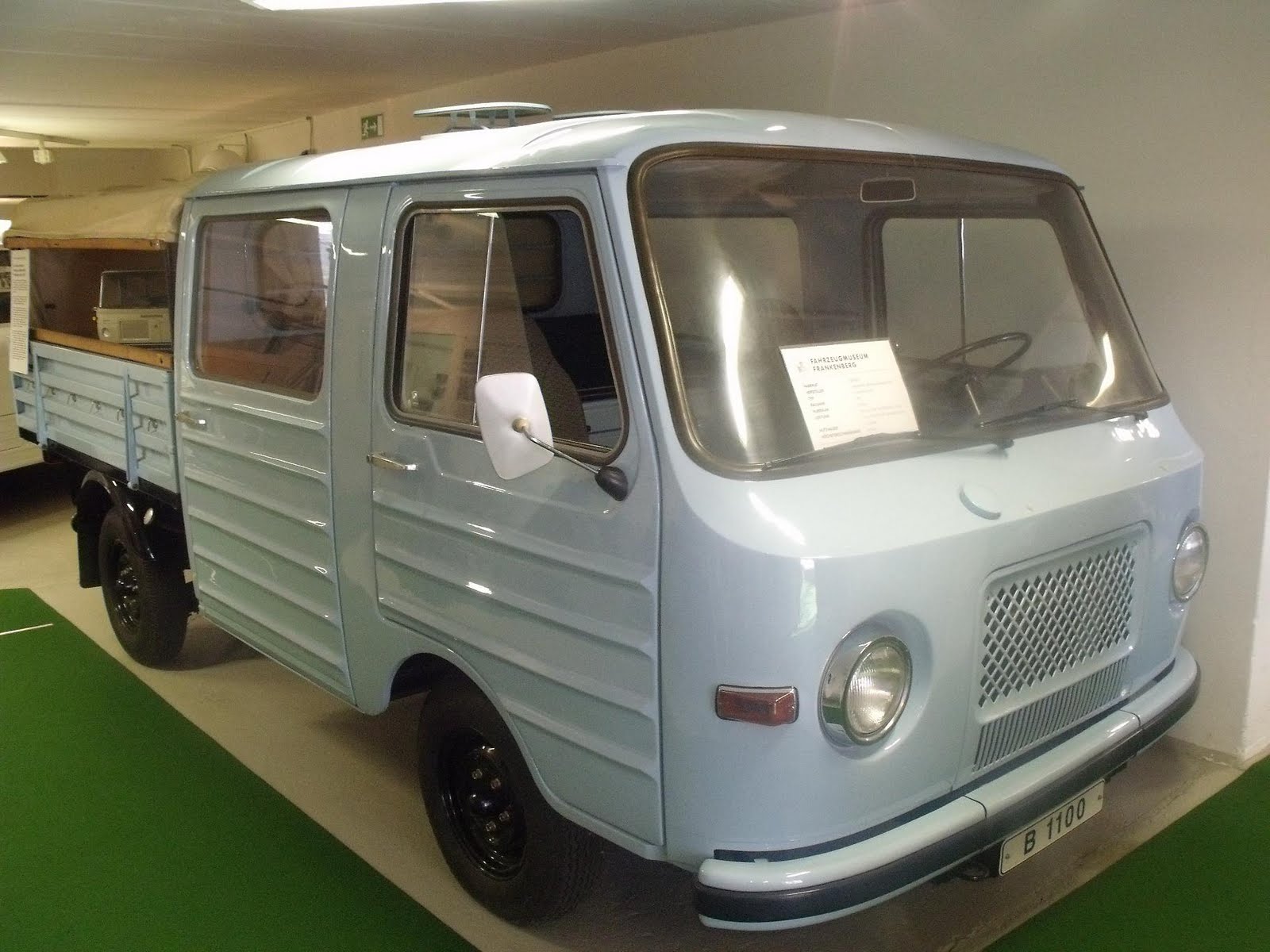
Interestingly the factory made a prototype in 1972, the Barkas B1100 which used  a
four stroke 1.5 engine  of Moskvitch origin, based on the Moskvitch 412 car, but approval
to build it was never granted. The prototype produced 75hp, with a top speed of
120 km/h( 75mph). The design, whilst boxy was quite futuristic and modern for its time.

They had a six-wheeler version, made as a car transporter, which used a 1500cc
Lada engine, and did make it into production from 1978 onwards.


Main change came in 1989 and the Barkas got the 1.3 Volkswagen  engine, shared with
the Wartburg 1.3. Barkas with this engine are signified by 1000/1.

There remains very few Barkas in existence today, at least good ones  and
a restored one or one in excellent condition will fetch more than three thousand euros
these days. They are so unusual though, that I feel if you could get one, they'd make a
super investment as they'll soon be rarer than hens teeth, especially when you consider
what Volkswagen  T2 vans are making currently. The two vans are comparable and
personally I'd much rather have the Barkas.
Main problem with their longevity was that old nemesis 'Rust' which gets many old cars
in the end. There must be hundreds of rusting Barkas hulks in barns and scrapyards
all over the former Gdr.


Just over 175,000 Two Stroke Barkas were made and almost 2000 four stroke models.

Friday, April 29, 2011

IFA F9 Road Test from 1955.

IFA F9 Road Test Review.

Zwickau built F9 1950-1953


This road test dates from 1955 and appeared in a Finnish magazine titled " World of
Technology".
Until the late 1950's, virtually the only cars available to the Finns were Eastern Block
vehicles and their choices were thus limited to Skoda, AWZ ( Automobilwerk Zwickau
(Trabant), Wartburg and Moskvitch.

Interior view of early Zwickau F9.


Reason for this was that Western cars were strictly rationed and only available to those
wealthy enough to get them, due to the hefty War reparations that had to be paid to
the Soviets.
Also, Western cars had to be paid for in Western currencies, which alienated this
possibility beyond the reach of the ordinary person.

Eisenach built F9 1953-1956


IFA F9

There cannot be anybody in Finland, who has not heard more or less unflattering
anecdotes about the IFA F9. Partly for this reason we wanted to find out what this
vehicle is really like. As we have no owner experiences as regards the durability of
the car, we shall refer to the appended statistics and tell you what it felt like to be
behind the wheel of a well sorted IFA.
When first stepping into an IFA F9, one notices the curved-backed aeroplaned-type
seats, which provide a steady, pleasant seating position.
The sharply falling bonnet gives good visibility ahead, but the visibility in other directions
is only average.
There seems to be sufficient room for four passengers.
The handling is enhanced by front wheel drive, which makes the IFA excellent in sharp
bends, as long as they are taken correctly under acceleration.
Another noteworthy characteristic is the freewheel, which saves both fuel and engine.
The correct way is to accelerate at intervals and then allow the car to roll under its own
impetus.
The steering is super fast rack and pinion, which feels odd after driving larger cars.
The unevenness and potholes in roads are felt unpleasantly through the wheel, but otherwise
the handling is brilliant.
The gear lever is handily placed on the dashboard, but gear changes have to be carried out
with care, for otherwise the gearbox will make nasty noises, especially when changing down.
The combination of the 3 cylinder, 32 hp engine and four speed gearbox gives the F9
reasonable powers of acceleration.
On tarred roads we got the following times:
0-50 km/h 9.5 seconds, 0-80 km/h 20 secs, and 1 kilometre from standing start 50 secs.
The engine noise is rather intrusive, especially in older models.
Braking  was not the best in the IFA's we drove, due to hard brake linings.
Handling is so good however, that this small inconvenience hardly deserves a mention.
The gauges worked perfectly and we did not notice any particular inaccuracies in the
readings.
The IFA F9 is reasonably comfortable. There is plenty of room inside and the doors are
sufficently wide to allow easy entry.
The body is reasonably tight and draught proof in Winter. This is helped by the presence
of inside lining of the body.

Eisenach F9 1953-1956


Good Points:

Good handling, cheap to buy, comfortable seats, low fuel consumption, widely available,
good starter in winter, roomy inside, freewheel spares engine and saves petrol.

Weaknesses:

Dodgy electrics, low quality tires, paintwork and chrome, expensive to repair, badly
finished, low quality springs, rubber joint in steering, central lubrication pump,
Non-professional repair personnel.

Technical Data:

Engine: Three cylinders, two stroke, output 32 bhp/limited to 3800 rpm.
Compression 6.8.1.  Cylinder dimensions 70 x 78mm, capacity 0.9 litres.
900cc.
25:1 Mixing ratio, petrol to two stroke oil.

Cooling: Water-cooled, radiator behind engine. 10 litre capacity.

Transmission: Dry single plate clutch, four speed gearbox with freewheel.
Gear ratios: 1st 3.27  2nd 2.133,  3rd  1.368, 4th 0.957 and reverse 4,44:1
Gear lever on the dashboard. Front wheel drive.

Suspension:   Half-elliptic crosswise springs front and rear.

Dimensions: Length 4.2 metres, width 1.6m, height 1.45m.
Wheelbase 2.35m. Width of front track 1.18m, rear 1.26m.
Unladen weight 870 kg. Load capacity 380 kg.
Top speed 110 km/h ( approx 69 mph)
Petrol Tank capacity 30 litres.

Fuel consumption: Urban 9.6 litres for 100km (62.5 miles) Approx 29.6 mpg.
Based on a metric gallon 4.55 litres.

Open road consumption: 8 litres for 100km (62.5 miles) Approx 35.5 mpg.

Thursday, April 28, 2011

Other classics I own

It would be fair to say that I love classic cars of all eras.
In addition to Two strokers I also have a passion for vintage vans and trucks and also modern classics.

My daily driver is a Rover 216 Coupe, 1995. It's one of the Rover's that was fitted with the Honda 1.6 16valve fuel injected engine and it's a cracker. It's quick, yet still reasonably economical and is nicely finished and appointed inside being a Rover. The car drives like a modern car, yet is stylish and looks like a 5 year old car rather than one that's 16 years old.
The seats are particularly comfortable on long journeys and the double, detachable  glass roof is a very nice feature.


The car was resprayed at some point to a high standard and the original Rover alloys are in very good condition.
I bought the car last November, when it had 73k miles on it and full service history from new.
I've since done about 4k miles on it and it's been utterly reliable.


Mot is due soon and I have replaced both CV joints and the silencer and given the car a full service myself, so she's on the button. I might be tempted to sell the car  with a full mot, as I could do with a diesel van for practical reasons.


I also have a '93 Leyland Daf 200 ( 2.0 petrol van) that I bought as a project.
The van has a bit of corrosion on the bottom of the back doors and on the wheel arches, but needs very little to sort out for the test. It will also need an exhaust., but that's about it. The van drives perfectly and the engine runs like a sewing machine and is very quiet.  The van is quite decent to drive despite no power steering. But, once on the move it's fine.


It was originally a mini-bus, so has glass windows down each side.
Someone at some point took out most of the seating except for the row behind the front row, making it like a 6 seat crew type van. Of course the seats just bolt in and out, so this row could be removed also to create even more space and a standard van.


This van could easily be made into a camper van quite easily with a rock n roll type bed fitted as it already has the windows down the sides and being originally a mini-bus the floor area is done out in carpeted plywood.
An electrician had this van before me, which explains why it's so clean inside.
I'm unsure what I'll do with the van, but |I'll probably do what I need to for the mot and decide after that.
These vans are very spacious for their size and are similar to a Ford Transit room wise.

Tuesday, April 19, 2011

New Car coming shortly

I've bought another two stroke car and will be flying to England to pick it up on May 11th.
All I''m saying at this point is that it's a lovely car in two- tone paintwork and is from the 60's era.
I plan on taking it to the top shows here in Ireland this summer.

More details to follow.

Monday, March 28, 2011

The Framo/Barkas Museum in Frankenburg. Visited 23rd Feb, 2011

The Factory Museum for the Framo and Barkas Commercial vehicles is in
the small town of Frankenburg, which is about 15km from Chemnitz.
Without my Garmin Sat-Nav we would have had difficulty finding the place
as it's not signposted and is not in the centre of the pretty little German town.
The Museum here is a small, very low key affair, but in some ways it was the nicest
of the 3 museums we visited.

Outside front of Museum


I had noticed that most days and on the day we were visiting, they only opened
from 1pm-4pm. I knew I was returning to Berlin that day, when planning our trip and had
emailed this museum in advance asking them if there was any chance we could
visit around 10.30-11.00 am.

LT 200


Surprisingly, and with typical German efficiency, the lady who works there daily,
emailed me back and said that that was no problem.
Not only that, but when we got there she had arranged an ex-factory employee to be
onhand to show us around the museum and presumably to answer any questions I had.
I say presumably because the poor man didn't speak any English and I only have a handful
of  German, so our meeting initially was somewhat farcical as I realised he expected
me to speak German. I had used an internet translation site to send them an email in German,
so I knew he expected me to be more conversant than I was able to be.

LT300


The Woman receptionist there has a few words of English and regardless of what language
anyone speaks or doesn't speak, it was obvious that these two people were delighted that
someone from Ireland wanted to visit their museum and learn about the history etc.
The man left us to wander around for a while and when I was taking pictures he helpfully
opened the bonnets of the cars so I could take shots of the engine bays and also invited me
to sit into any of the vehicles I wanted to.
Small kindnesses and gestures mean a lot especially when it's difficult to communicate.
This was a nice gesture after visiting the Horch Museum and the one in Eisenach, where the
cars are all kept locked and the Horch museum all had signs up saying 'Don't touch'.

Barkas B1000 


The Museum is small and I doubt it receives many visitors. I met a Trabant Rally driver
who lives only 15 minutes away from it and he admitted he'd never been to see the exhibit.
But although small, it has an impressive selection of vehicles and an interesting history.
The Museum opened to the Public in 1993.

The brand FRAMO is the predecessor of what would become BARKAS and  started
up here in Frankenburg in 1923. Framo is short for Frankenburg Motor Works and the company
was founded by the man behind DKW, Jorgen Rassmussen and two colleagues Richard Blau,
and  local man Paul Figura.


Barkas B1100 prototype with 1500 Moskvitch 4 stroke engine. 1972


Intially though the company was named Metall-Werke Frankenberg GmbH (Frankenburg
Metal Works)
The company was set up to manufacture Motorcycle parts for the DKW Motorcycle Plant
in Zschopau, which it did successfully until 1927.
Then, production started in the Frankenburg factory of a three wheeled motorised Tricycle, the
TV 300. This was no ordinary trike and was sturdily built as a freight vehicle for the transporting
of goods and merchandise for local businesses.
As the name suggests it was powered by a 300cc, 2 stroke engine with only one cylinder.
The engine came from DKW.
The lightweight design and reasonable price made these trikes popular with tradesmen and local
shopkeepers like Butchers and Bakers.
Further, similar designs would follow in much the same vein, with slight variations and engines
 usually of either 200 or 300cc.


Production moved from Frankenburg to Hanichen in 1934 and the company would soon branch into
four wheel vehicles, including a car called the Piccolo.
It is from 1934 that the company was renamed as Framo-Werke Hainichen
 The Piccolo car was not a success and sold in few numbers,
 after which the Factory reverted back to making small commercials with three and four
wheels.

1961 Framo V901/2


In 1938, the Company brought out a range of small vans and pick-up trucks that used a 500cc
DKW engine, with two stroke power and two cylinders.
 This was known as the V500 and was a big success for Framo.
Then development stopped with the onset of War and the factory was retooled to supply weapons
for the German Army.
Around 500 Female Prisoners of War were conscripted to work in the Hanichen Factory for the War
effort. These prisoners came from the nearby Flossenburg Concentration Camp, that had a
sub-camp in Hainichen.

When the War ended in 1945, this area of course was within the Russian Sector and the factories
were dismantled, crated up and sent to Russia as War reparations.
The Hanichen factory regrouped eventually and started again to produce their V500 model from
1949, with the models designated as V501/502.
In 1951, the larger but cosmetically very similar V901 and V902 were created and displaced the
smaller 501 and 502 eventually.
The V900 models used an adapted version of the IFA F9 engine, itself a DKW pre-War design and
copy.


In 1961 a new factory was built in Karl-Marx-Stadt ( now Chemnitz) to produce a new commercial
van type vehicle, named the Barkas.
That year, the Barkas B1000 was launched and was way ahead of its contemporaries
 and the competition.
It used the Wartburg 353, 2 stroke engine of only 993cc and the gear box from the
same car.
Surprisingly it went rather well and wasn't as seriously underpowered as you would think, thanks
to an ingenious exhaust system that generated huge amounts of torque that enabled it to pull
a ton of weight plus its own.
The downside to this was poor fuel economy. Nomatter how hard or easy they're driven, it seems
that 20-23 mpg is all they return. Top speed was good for approx 60mph.
Their weak spot was the clutch that wasn't strong enough for a commercial vehicle, having been
made for the Wartburg 353 car and most Barkas's would have seen a clutch or few in its time.

3 fine Framo's with 500cc 2stroke power


The Barkas was made in several variants, a van, pick-up, flatbed truck, a minibus
 and customised versions for the Army, Police, Ambulance and Fire Department.
It was comparable in quality, usability and reliability to the VW Transporter van of the same era.
It's pretty remarkable that a one litre engine could carry a Ton of weight, which added to its own
would be close to 2.5 tonnes, yet the Barkas was well up to the job and was the only small
Commercial of its kind made in East Germany, so it saw plenty of use from Emergency
Services to Tradesmen to Delivery men. It was manufactured  in two stroke form
until 1990 and until 1991 in four stroke, when it received the VW engine that the Wartburg
1.3 got in its final stages of production.

that superb Barkas chassis!


So how did it manage to pull and carry such weight?

front view of chassis mated to 1.3 VW engine


The answer is a combination of things, but the biggest single factor in this is the chassis
of the Barkas which needs to be seen up close to be believed and appreciated.
It's an incredibly sturdy creation made from heavy steel that incorporates a huge outrigger
on each side that takes the bulk of its payload and by so doing, takes the pressure and
stress of the engine and gear box. This, added to the huge torque supplied by the
ingenious exhaust system and you have a very capable, commercial vehicle that belies
its small engine.
The van was also front wheel drive, typical of the Dkw inspired mechanicals, but very
unusual for a commercial van type vehicle in 1961.
The suspension also used semi-trailing arms which was quite advanced for this type
of vehicle.

engine bay of Barkas B1000 between front seats. Two stroke engine


There's a particularly fine Barkas, custom made for Hohenschonhausen Prison in East
Berlin and displayed there. It was made to look like a fish delivery van from the outside
but inside had six individual holding cells for prisoners.
The engine of the Barkas is situated between the two front seats, so the body shape
really makes the most of the space it has inside. The 9 seater minibus type has loads
of room inside and is more spacious than the VW model of the same time.

Barkas, like AWE and Sachsenring made many prototypes of both engines and vehicles
that never made it into production. The Museum has a fine Barkas B1100 prototype that
looks like a fine vehicle, especially when it was made in 1972 and was intended to replace
the B1000. This prototype used a 1500cc, Moskvitch Four stroke engine.
Sadly, this and many others from all the East German auto makers was denied by the
powers that be who would spend as little as possible on new technologies.

I really enjoyed this visit to all three museums and getting to see parts of the former
Gdr was good too. I expected general costs to be cheaper, most consumer goods
and eating out was more expensive than Berlin.
But, Berlin is a very cheap city to spend time in. More competition I guess is healthy!


Author pictured in Barkas B1000

Monday, March 21, 2011

AWE Automobile Werks Eisenach. The Wartburg Museum. Feb 22, 2011

We spent about 3.5 hours in the Horch Museum and then drove to Eisenach which
is roughly 120 miles further East of Zwickau.
EMW 340 Ambulance


We decided to go straight to the Wartburg Museum in Eisenach, which is situated
in part of the old car factory AWE, rather than first checking into our Hotel.
The drive only took 1 hr 45 mins as it was mostly Autobahn and we arrived at the
museum with about 2.5 hours to go before it closed.
The museum is a cracker, although much smaller and less grand than the one
in Zwickau. It was more homely and relaxed though and we saw only two other
people there the whole time we were in it.
The cars though were in superb condition and showed the full range of cars made
there in their production history that dates back to 1898.
We saw Austin 7's built under license in the 1920's to the Bmw's of the thirties and
forties and the EMW models built in the early fifties,
right through all the Wartburgs models from 1955-1991, until the factory closed.

EMW 327 Cabriolet 1953


This factory was the old Bmw factory before WWII and like Dkw in Zwickau, Bmw
left for  West Germany when their Eisenach factory and it's presses, tooling
and pretty much anything of value in the East was about to be plundered by the Soviets and
sent back to Mother Russia.

Unfortunately for Bmw, Eisenach was in the heart of the Soviet Sector, despite the
fact it was actually American forces that liberated Eisenach in 1945.
The Soviets had no compassion for Bmw, who had been making Aircraft engines
for the German war effort in this very factory.
With the stripping of the factory imminent, the workers at the plant managed to assemble
a few cars from salvaged parts and components they managed to forage and gather.
This showed the Soviets what the factory and its skilled work force were capable of
turning out and this in turn persuaded the Soviets that the factory was worthy of remaining
open and plans were drawn up for its rebuilding and recommissioning.
The workers in the immediate aftermath of the War had had to content themselves with
making wheel barrows and handcarts , so this news must have exceeded their hopes and
expectations.

IFA F9 Built in Eisenach


After the War and Bmw left their Eisenach Works to the Communists, the pre-war
Bmw models continued to be made and sold from Eisenach (mostly export sales).
The continued to be badged as Bmw's until 1952, when Bmw took the factory to court
for continuing to use their brand. Thus, the cars were then made same as before, but
now branded as EMW's ( Eisenach Motor Works). They even used the same style
of badge, but substituted the blue squares of Bmw for red ones ( Red signified
Communism of course).
The museum has some superb examples of these cars on display and the quality
of the workmanship is a joy to behold. The paint and quality of the coachwork and
flowing lines rival the cars produced by Horch in Zwickau.
That car makers were capable of producing such superb feats of engineering and
finish in these times is hard to believe and a real eye opener.
The 340 and 328 models are particularly fetching and cars to be put on the wanted list
for when I win the National Lottery!

EMW Badge


Production of the EMW's stopped in 1955 and car production here would be
for two stroke vehicles until some Wartburgs were produced briefly in 1989/1990
with a four stroke engine.
The IFA F9 had been made in Zwickau from 1950-53 and this was now switched
to Eisenach, who made it up until 1956.
This was a popular car in East Germany and it was available in many formats,
saloons, estates, cabriolets and commercial variants.


I know from research that the workforce that had learnt its skills building Bmw's and
Emw's were more than a touch dispondent to find themselves now building the F9
which was seen as a mass produced and somewhat basic car.
Their enthusiasm and optimism returned though with the development of the 311,
whose stylish looks and classy design more than made up for whatever reservations they
had about using two stroke engines.


F9 built in Eisenach 1954


The Wartburg 311 appeared in 1955 and was built exclusively at the Eisenach
Works. Although it had a new, very beautiful body, the engine, gearbox and
chassis came from the F9, which the new car replaced.

Fabulous 311 cabriolet


The name 'Wartburg' was also reintroduced as a car marque, but not until 1960,
the name having been dormant for many years.

Using the major mechanical components from the F9, enabled the IFA to
produce what looked like a totally new car, and keep development costs down
to a minimum. ( in modern times, Peugeot and their sister company Citroen have done this
to great and profitable effect. Likewise VW have done the same with Seat and Skoda
sharing platforms and engines.)
Although the chassis was the same, the 311 is a bigger car than the F9, with more
road presence and usable space inside the car.
The engine of course was developed by Dkw in 1939, but held back by the War
and first used by the Communists since 1950, whereas Dkw took time to regroup
in the West and didn't get to use their own engine until 1953.

Wartburg 313/1


All the cars made here from this point onwards would use the separate chassis
that these days, Wartburgs have become famous for.
The chassis is remarkably sturdy and resists rust particularly well, helped by
the rust-proofing carried out at the factory.
Later models would have a revised chassis that had coil springs at each wheel,
but otherwise the chassis shape and solidity remained the same.
The early cars had leaf sprung suspension that gave the 311 unparalleled cornering
abilities for its time, as the set up virtually eliminated body roll.
311's from its inception in 1956 to 1960, were branded 'Eisenacher', with Wartburg
being the model, not the brand.
From 1960 onwards the brand was known as 'Wartburg' and the car was known as
the Wartburg 1000.

Gorgeous interior 311 cabriolet


Looking at the various 311's in the factory museum, they were a thing of beauty
which is unusual for cars made under Communist enterprise of any era.
Communist vehicles typically are made for ruggedness, simplicity and ease of
maintenance, and ascetic properties.
The 311 and to a lesser extent, the F9 had the rugged and simplistic traits, but
also embodied flowing lines, luxury of fittings and pure look of quality that harked more
from the BMW/EMW era than from a Communist one.
In 1962, the engine 900cc engine of the 311 was changed for the new 991cc, 2 stroke
unit with more power and higher speed.

It's only when you see the 311 and the F9 side by side, that you appreciate the
difference and what an accomplishment the styling of the 311 was.
The F9 viewed separately is a very nice looking car, but next to the 311 it looks
somewhat cheap and  crude.

Wartburg 311 Limousine


The early 311's had 37hp , while the new one had 45hp. The 0-60 time was also improved
by 6 seconds on the standard cars respectively.

313/1 Isn't it a beauty?


The 311 was a gorgeous looking car in all its variants and there were many of them.
Saloons, Convertibles, Coupe's, estates, coupes, even Army versions.
The Sports coupes made are in my view absolutely fantastic looking and
are the most desirable two stroke cars ever produced by anybody.
The 313 Sportwagen Coupe and Convertible models are arguably the pick of
the cars on display in this museum.
They had two carburettors and were only produced from 1957-1960, so used
the 900cc engine. Nevertheless they produced 50 Hp and had a top speed of
140 Km/h. They had sumptuous leather seats and when you look at them, you
could just as easily believe you're looking a Mercedes, the appearance and overall
quality apparent, being of the same standard.
I don't know why they named it the 313, as it is the same as the 311, other than
the changes mentioned.
Other notables in the museum are the 311 Convertibles and the Camping, estate
versions offering great versatility and practicality with style.


The 312 model replaced the 311 in 1965 and was produced for less than 2 years.
It was a cross over model used to test a new chassis that had been developed
with coil springs. The body looked the same but it had a wider front track
and later models would use a different carburettor.

The other changes of note at this time was a new gear box and newly designed
drive shafts that used needle bearings and were far advanced for their time.


In time the power output increased from 45 to 50 hp, yet even with this increase
the 311 is regarded as being faster than the 353.

The coil springs gave the car a softer ride over poor road surfaces, but also increased
body roll and lesser cornering ability at speed than the transverse leaf springs.


The reason for this model was for the impending new car that Wartburg were
putting the finishing touches to and would be the Wartburg 353 which was
available to buy from 1966.
Gone were the flowing curved lines of before and replaced by a 3 box type
design, so commonplace amongst Communist car manufacturers from this
point onwards.
It would have been seen at the time I suppose as modern and progressive,
especially with an eye to what the West were producing at the time, but
with the benefit of hindsight, I think this styling was a mistake.
The 353 shared the engine of the 312, albeit in time with an incease in Hp and
of course the chassis etc. Basically it was the 312 with a new body in the same way
the IFA F9 was used in the development of the 311.

The early 353's were the nicest  as they used quite a bit of chrome in the
bumpers and trim etc. They also appear to have had better seats and are not as austerely
finished as later models became.
The finish of the 353's got cheaper as time went on and this probably reflects the overall
state of the Gdr at the time throughout the eighties. They were hemorrhaging money
as fast as their planned economy and 'Workers Paradise' was failing.
The export models of the 353 were much better finished than those for their own
domestic market and the cars that went to other Communist States.
By the mid eighties, the chrome trim was replaced with plastic, the switchgear inside
the cars had a cheaper feel and the seats were of a lesser quality.
Although the 353 was a good car and mechanically similar to the 311, it's a poor
looking car by comparision, in terms of style and visual appeal.
It was utilarian, robust and practical, none more so than the estate version known
as the Tourist.
The Tourist is practical and a great load lugger, but the estate styling is even boxier
than the saloon and looks very Eastern European, and Lada-like.
I think the styling of the 311 reflects the hope of a new country, the establishment
of the Gdr and all its hope and dreams for the future. The bland, cost cutting,
practical styling of the last 353's by comparison reflects the failure of those dreams
and a country falling apart at its political and financial seams, hanging on and making do
as best they can.


The 353 used basically the same engine as the 311, with only minor changes until
1989, when it got the four stroke 1.3 VW Polo/Golf engine fitted until the factory
dissolved and was bought out by Opel in 1991.
The IFA had been making this engine under contract for a few years and also
the 1.1( 1043cc) engine that saw use in the final Trabants, for VW and probably
received the engines in part payment.
As in the case of the last Trabants, it was thought these engines would make the
two home grown cars more appealing to their own people who could buy any
Western brand of car they liked since the Wall opened in Nov '89.
It was a vain effort and one that failed on both counts.


Eisenach itself  is a nice looking Town, dominated by the Wartburg Castle that was
used by Martin Luther. It's quite hilly and almost Alpine looking in it's layout,
appearance and style of its houses.
The Town centre is quite small and easily traversed on foot.
There's not much to it really but the streets have a nice layout and everything
is compact and easily accessible within a small area.
Like Zwickau though, after 7pm it seemed empty and dead.
I had booked a Hotel/Guest House in advance in 'Villa Bomberg' a 3 storey
house that was most unusual in its layout and style, but very comfortable and
very nice.
It was roughly towards the Castle if heading there from the Town Centre, set
back amidst a nice residential area. Parking was freely available on the street
outside which was welcome as there was no private car park.
The Vendor made clear to me that I was best to leave the car on the street
and walk into the Town, rather than park there.
After the experience in Zwickau with the parking ticket, I knew exactly
what he was saying!
The Vendor was an extremely nice and helpful man, who although only
spoke a minimum of English, made himself understood with gestures.
The Room here was 50 euros for the night, with 5 euros extra per person
each for breakfast.
Rooms in Eisenach are a bit dearer than those available elsewhere in Germany
as the Town receives a bit more Tourism than the likes of Zwickau and Chemnitz.
My internet search beforehand yielded only the 'Ibis' Hotel as being slightly cheaper
than our choice and it was outside the town a bit and had a lower star rating.
I've stayed in Ibis hotels before and it would have been very similar to the Etap
in Zwickau, but at about double the price.
Villa Bomberg was a good choice and I would recommend it. The house was
very warm and comfortable in contrast to the minus ten weather outside.
After a good night's sleep and a nice breakfast, We set off back towards Berlin,
via Frankenburg, near Chemnitz, where we had arranged to see the Framo/Barkas
Factory Museum there.